final int8+zlib round-trip BPB
Graph-token reasoning under a BPB artifact budget
ToricGT
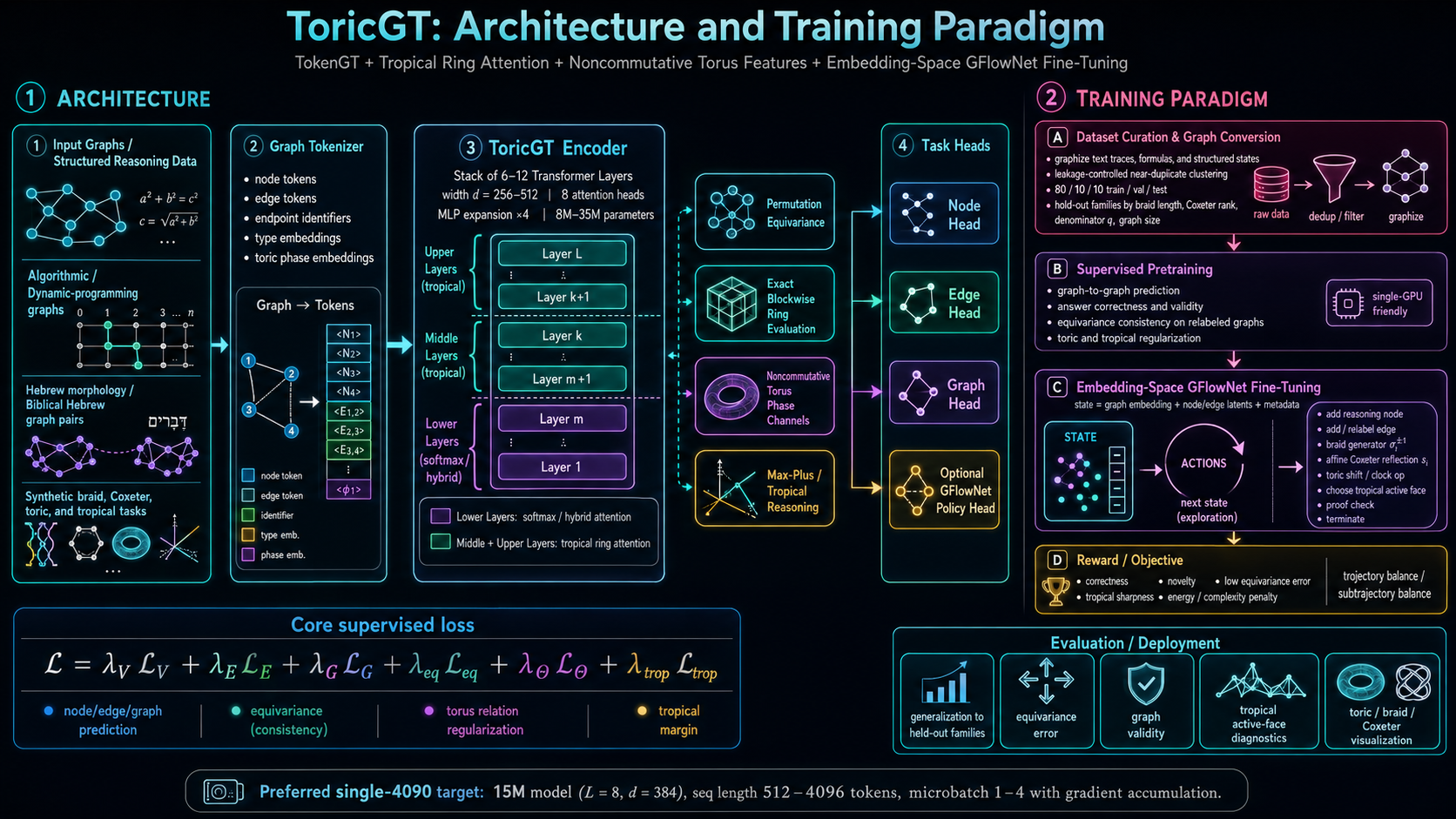
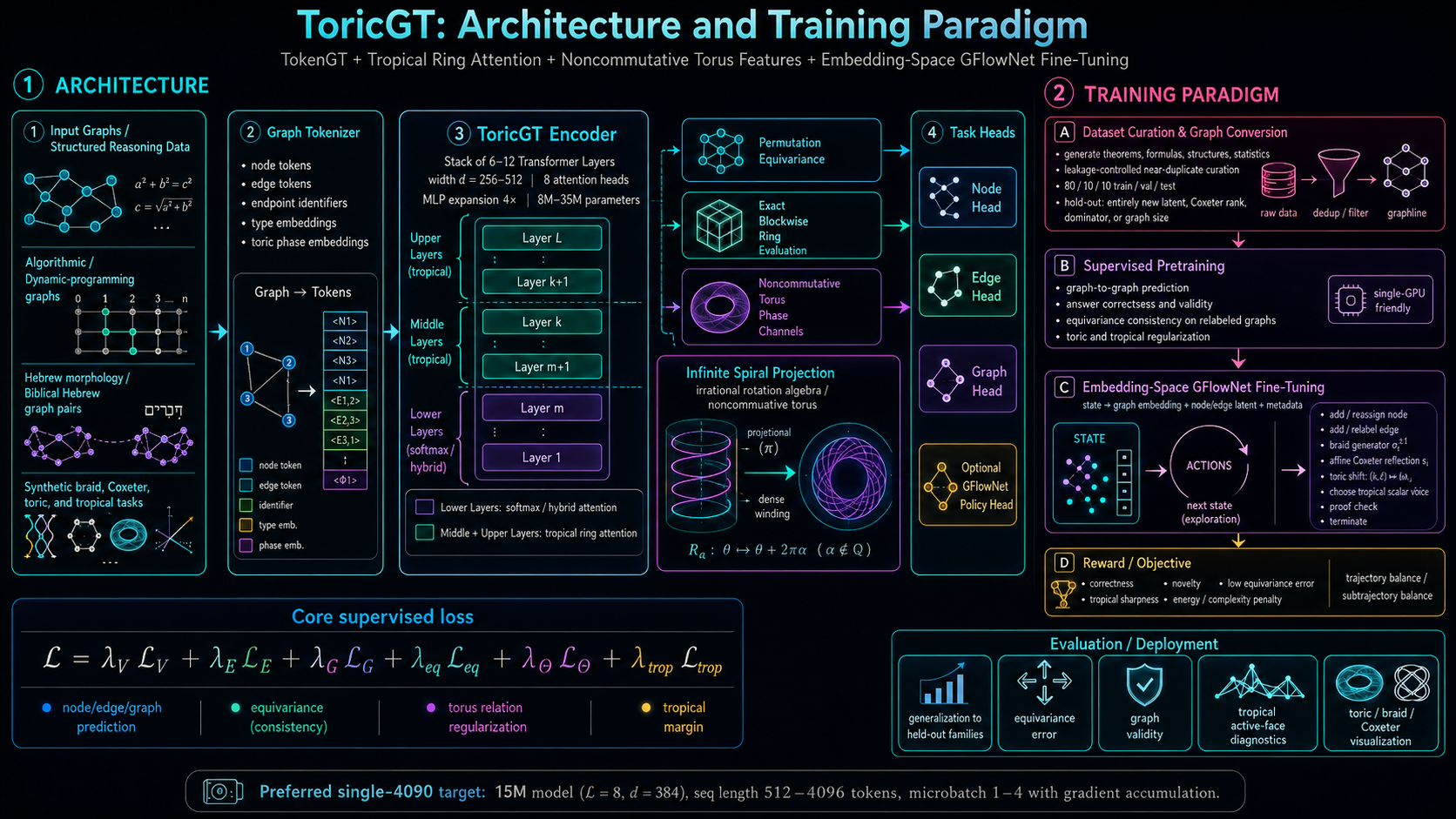
ToricGT embeds tropical ring attention into toric geometry, then uses graph tokens, Forest-of-Thought search, persistent homology, Toric BGG certificates, vector-bundle one-dimensional-cone sheaf audits, and BPB-first training to pressure compact language models toward structured reasoning.
Best Completed Run
score on the OAI FineWeb validation stream
latest train-side BPB in the selected run
model artifact before code/dependency accounting
Campaign BPB Trace
Lower bars are better: BPB is a cost, so the best run is highlighted in green and should sit closest to the baseline.
Campaign tg-bpb-bestof10-convextok2048-det-20260621T040717Z restarts from step 0 each attempt. Current best profile: gate2500_experimental_family_selective. Best run id: tg-bpb-bestof10-convextok2048-det-20260621T040717Z-r008-gate2500_experimental_family_selective-20260621T154110Z.
Core Metrics
| final_int8_loss | 0.842962 |
|---|---|
| final_int8_bpb | 0.4953 |
| val_loss | 0.838000 |
| val_bpb | 0.4924 |
| train_loss | 0.855800 |
| train_bpb | 0.5036 |
| graph_lm_bpb | 0.2962 |
| checkpoint_step | 1000.0000 |
Competition Context
Lower BPB is better. ToricGT is shown with the current local best exported run, followed by the official top five entries listed in the local OpenAI Parameter Golf clone.
| Status | Run | BPB | Author | Summary | Date | Info |
|---|---|---|---|---|---|---|
| pending | ToricGT ConvexTok-2048 Graphified FoT | 0.4953 | Amelie Schreiber | ToricGT ConvexTok-2048 with first-class TokenGT graphification, OAI-only flattening, FoT/GFlowNet heads, MTP, GraphCG, toric/BGG/Koszul/topological audits. Pending Parameter Golf PR review and independent verification; local capped validation BPB 0.4924. | 2026-06-21 | checkpoint · PR/status |
| 1 | Calib32 Token-Only N-gram + AsymLogit Stack | 1.0565 | codemath3000 | On PR #2135: pre-cutoff PR #2130 architecture rerun on clean canonical CaseOps data with GPTQ_CALIBRATION_BATCHES=32; 3-seed mean 1.05651 under grace policy (p=0.014 vs PR #2014) | 2026-05-01 | info |
| 2 | Progressive Context Growth + Short-Doc Score-First TTT | 1.0576 | simonbissonnette | On PR #2014: PR #1855/#1953 CaseOps stack with progressive context growth to 3k plus short-doc score-first TTT on the AWQ-lite/AsymLogit lineage; 3-seed mean 1.05759 (p=0.011 vs PR #1953) | 2026-04-30 | info |
| 3 | Long-Context No-Q/V TTT + QK-Gain 5.25 | 1.0586 | andrewbaggio1 | On PR #1953: PR #1945 V21 base with 2560 eval/TTT context, no-Q/V TTT mask, TTT LR 0.75, and QK_GAIN_INIT=5.25; 3-seed mean 1.05855 (p=0.063 vs PR #1945 V21 v2) | 2026-04-30 | info |
| 4 | AWQ-Lite GPTQ + AsymLogit on PR1855 Stack | 1.0594 | alertcat | On PR #1945 commit 70067534: PR #1855 stack plus PR #1908 AWQ-lite mixed GPTQ and PR #1923 AsymLogit; V21 v2 3-seed mean 1.05943 after strict seed-42 rerun (p=0.034 vs PR #1855) | 2026-04-29 | info, commit |
| 5 | BOS-Fixed SmearGate + LQER + SparseAttnGate + 9-Hparam Stack | 1.0611 | codemath3000 | On PR #1855: BOS-fixed #1797-derived stack with LQER, PR #1787 SparseAttnGate/PolarNS/FusedCE base, per-group lrzip compression, and 9 greedy hyperparameter overrides; submitted 3-seed mean 1.06108 with broader reproduction support (p=0.188 vs PR #1868 latest rerun) | 2026-04-27 | info, repro |
The ToricGT row is not claiming accepted leaderboard status. It is a pending experimental/non-record candidate until the Parameter Golf PR, tokenizer accounting, reproducibility checks, and official review are complete.
What Is Being Optimized
BPB stays primary. The advanced losses are small, evidence-weighted pressures that shape hidden graph structure, retrieval, toric/tropical geometry, and algebraic consistency without letting those objectives dominate byte likelihood.
- graphcg_loss0.011413
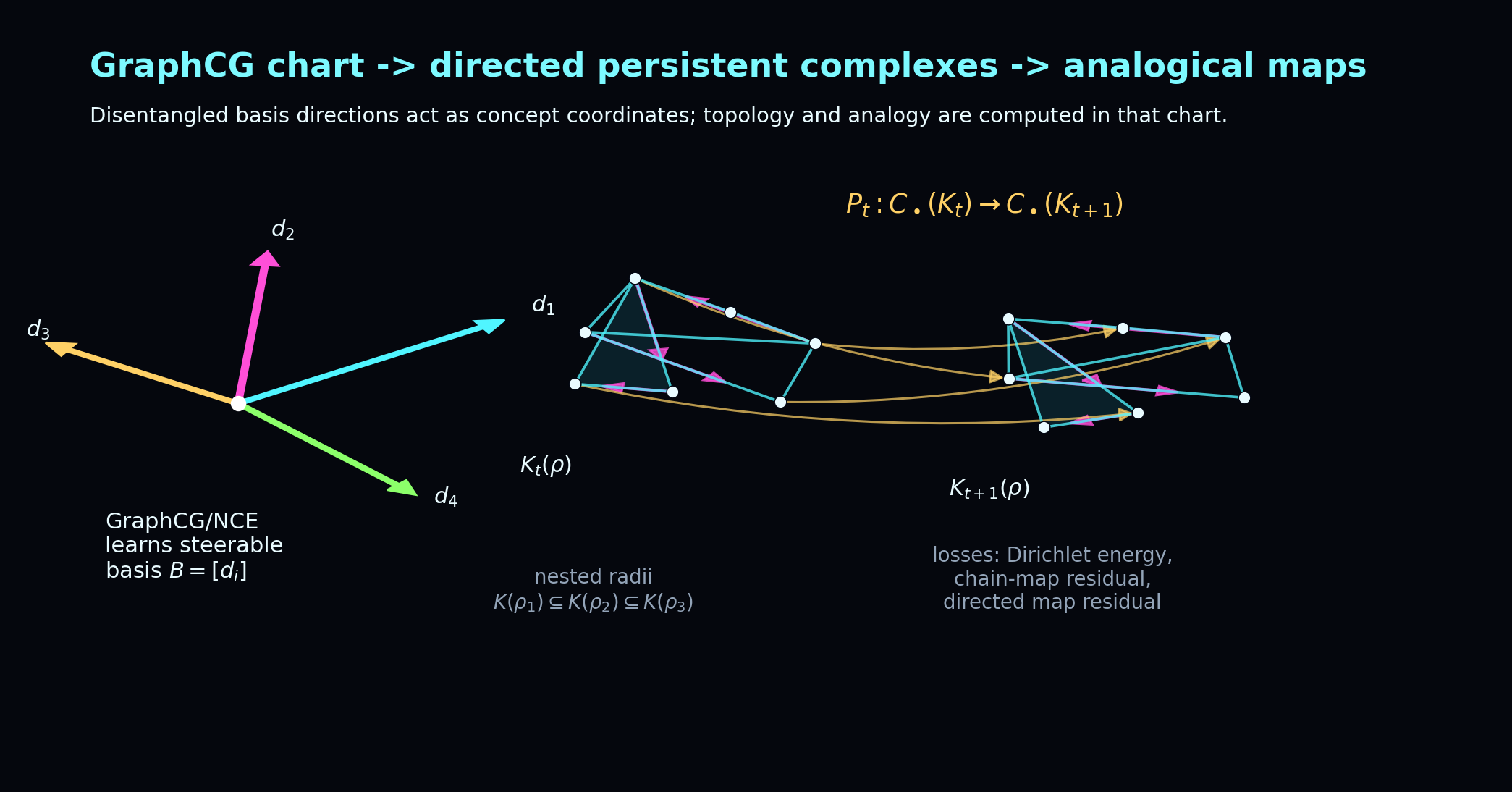
Full-rank GraphCG pressure: disentangles latent concept axes so graph and byte objectives can expose stable directions rather than collapsing into one entangled basis.
- analogy_loss0.064827
Analogical-retrieval lattice loss: encourages maps between reasoning memories through simplex-tree and vectorized persistent-homology similarity gates.
- tokengt_graph_loss1.162810
First-class TokenGT graph objective: trains causal node, edge, endpoint, distance, torus, and tokenization-DAG features used by the OAI FineWeb adapter.
- memory_loss1.140689
Trajectory-memory retrieval loss: selects reusable reasoning traces and stabilizes retrieval-conditioned auxiliary routing.
- toric_geometry_loss5.884988
Toric embedding and fan audit loss: keeps tropical ring attention active faces embedded into toric charts with interpretable cone/fan structure.
- toric_vector_bundle_1d_cone_ce_loss0.704291
Toric vector-bundle one-dimensional-cone/sheaf CE: regularizes per-cone filtrations and sheaf-style compatibility across fan neighborhoods.
- toric_bgg_loss0.164997
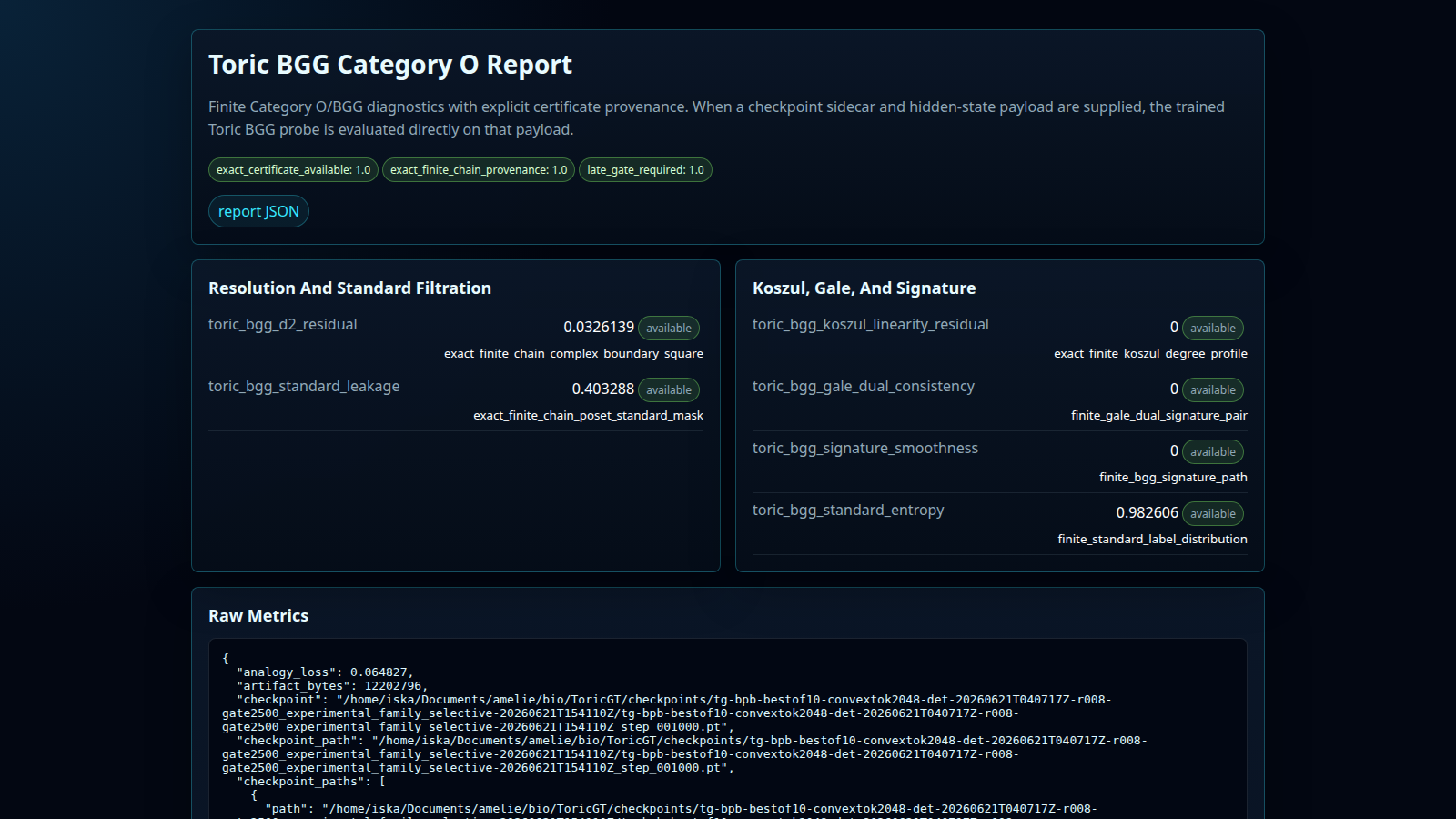
Toric BGG category-O supervision: keeps finite category-O certificates, standard filtrations, Gale-dual labels, and differential consistency visible.
- koszul_persistence_loss0.045398
Koszul/persistence loss: checks filtered complexes, multigraded modules, and chain-complex consistency for topological reasoning traces.
- toric_cca_topology_loss1.045991
Combinatorial toric commutative algebra/topology loss: tracks monomial staircases, syzygies, and CAS-backed toric module diagnostics.
- derived_signature_loss3.243159
Derived-signature distillation: compresses resolution, chain-map, and derived-category evidence into low-rank signatures for training-time audits.
- oai_gflownet_loss1.715701
Embedding-space GFlowNet loss: samples graph-of-thought continuations with reward tied to byte-likelihood, retrieval utility, and structural diversity.
- oai_fot_loss5.027384
Embedding-space Forest-of-Thought loss: searches branching reasoning forests and uses BPB-delta reward to prioritize branches that improve compression.
- oai_mtp_loss11.487040
Multi-token prediction loss: adds short-horizon targets that improve early byte likelihood while staying compatible with graph output flattening.
- graph_lm_loss0.368675
Graph-LM primary loss: trains graph-structured records directly while FineWeb output flattening remains optional and BPB-focused.
Conceptual Helpers
These small animated sketches summarize the operational math: tropical dynamic programming, toric embedding, reasoning forests, and persistence-vector retrieval.
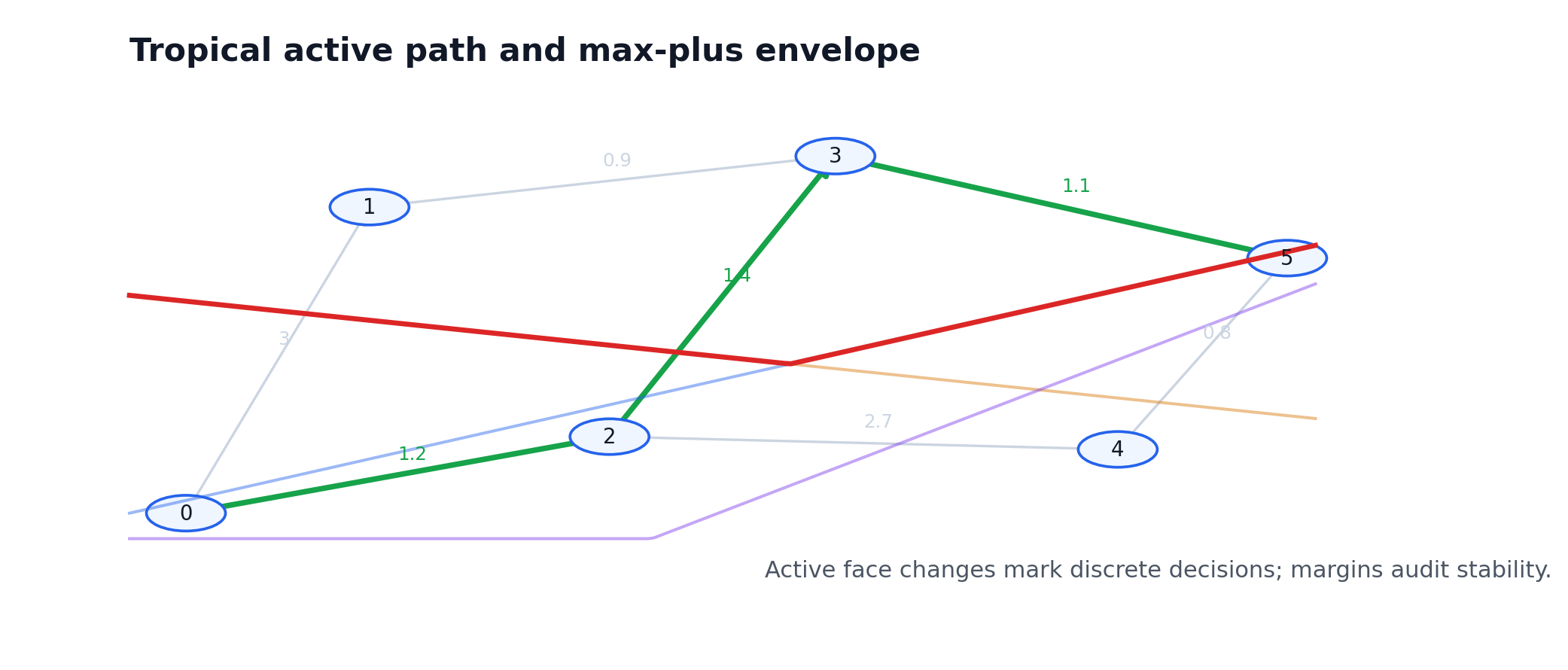
Tropical Path
ConvexTok and tropical attention both expose min-plus or max-plus active paths with margins.
Toric Fan
Active tropical faces are embedded into toric charts so cone, divisor, and one-dimensional-cone audits become meaningful.
Forest Search
Embedding-space FoT/GFlowNet branches are rewarded by BPB-delta and structural diversity.
PH Retrieval
Analogies require simplex-map evidence and vectorized persistent-homology agreement.
Visualizations
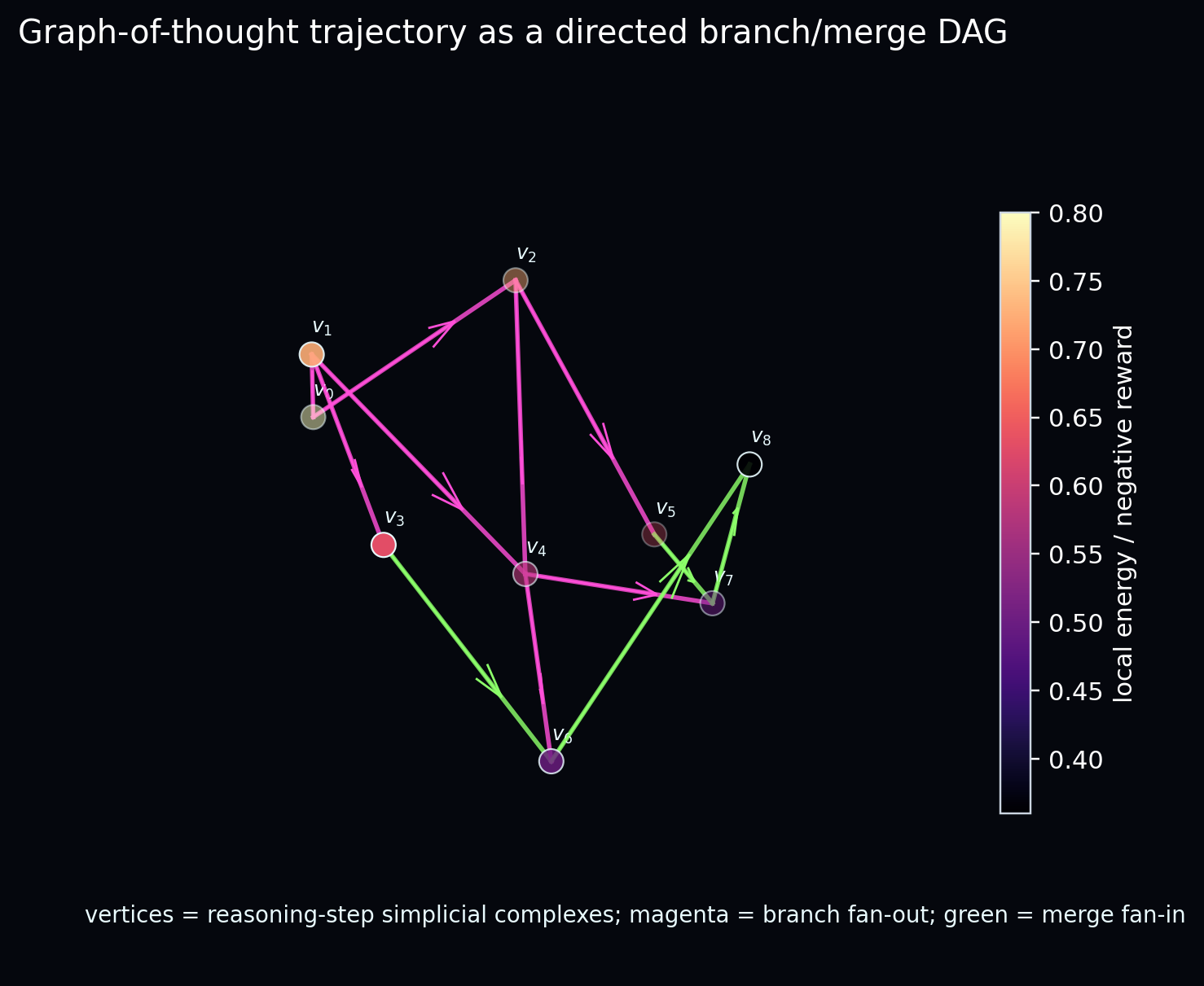
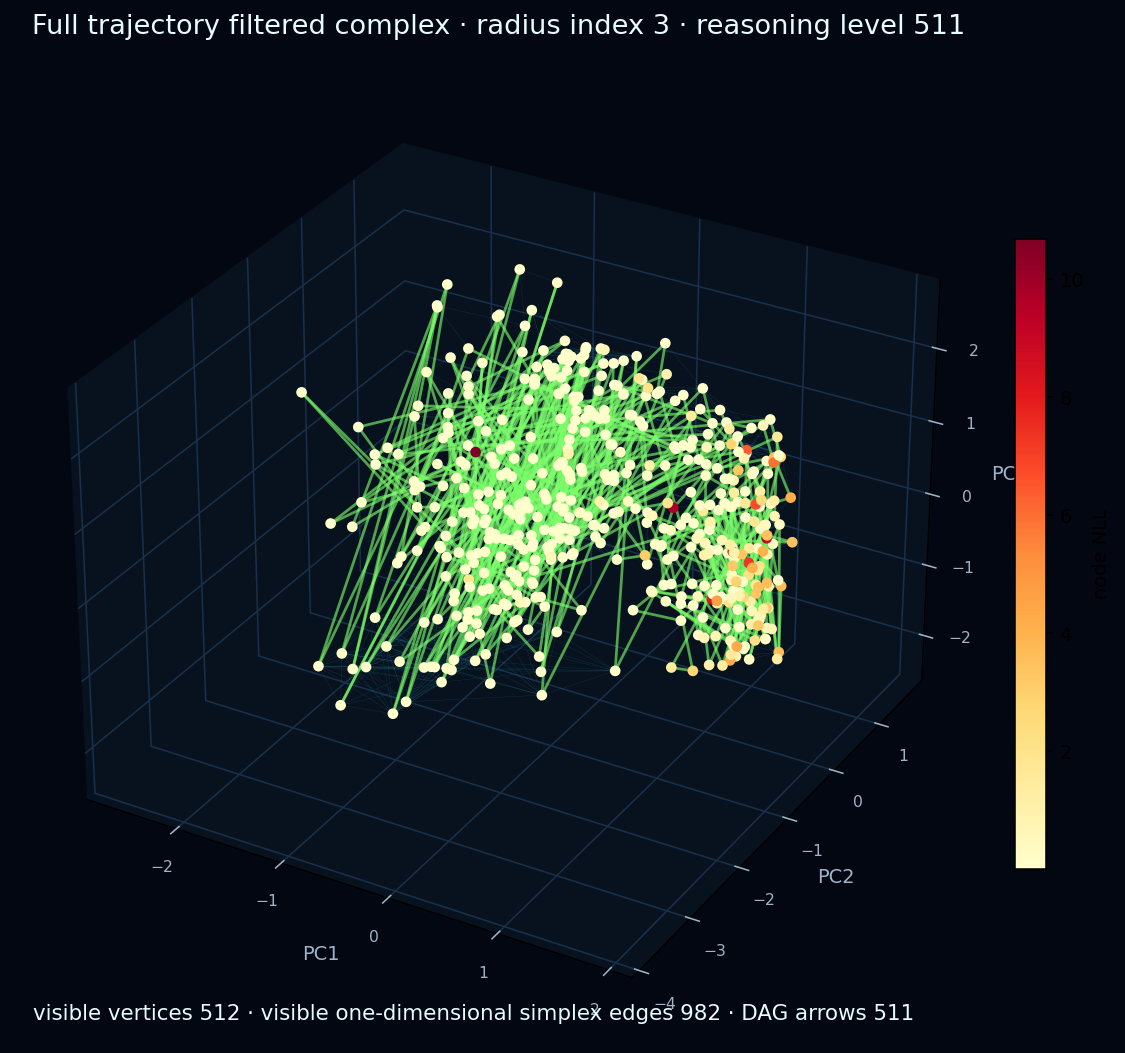
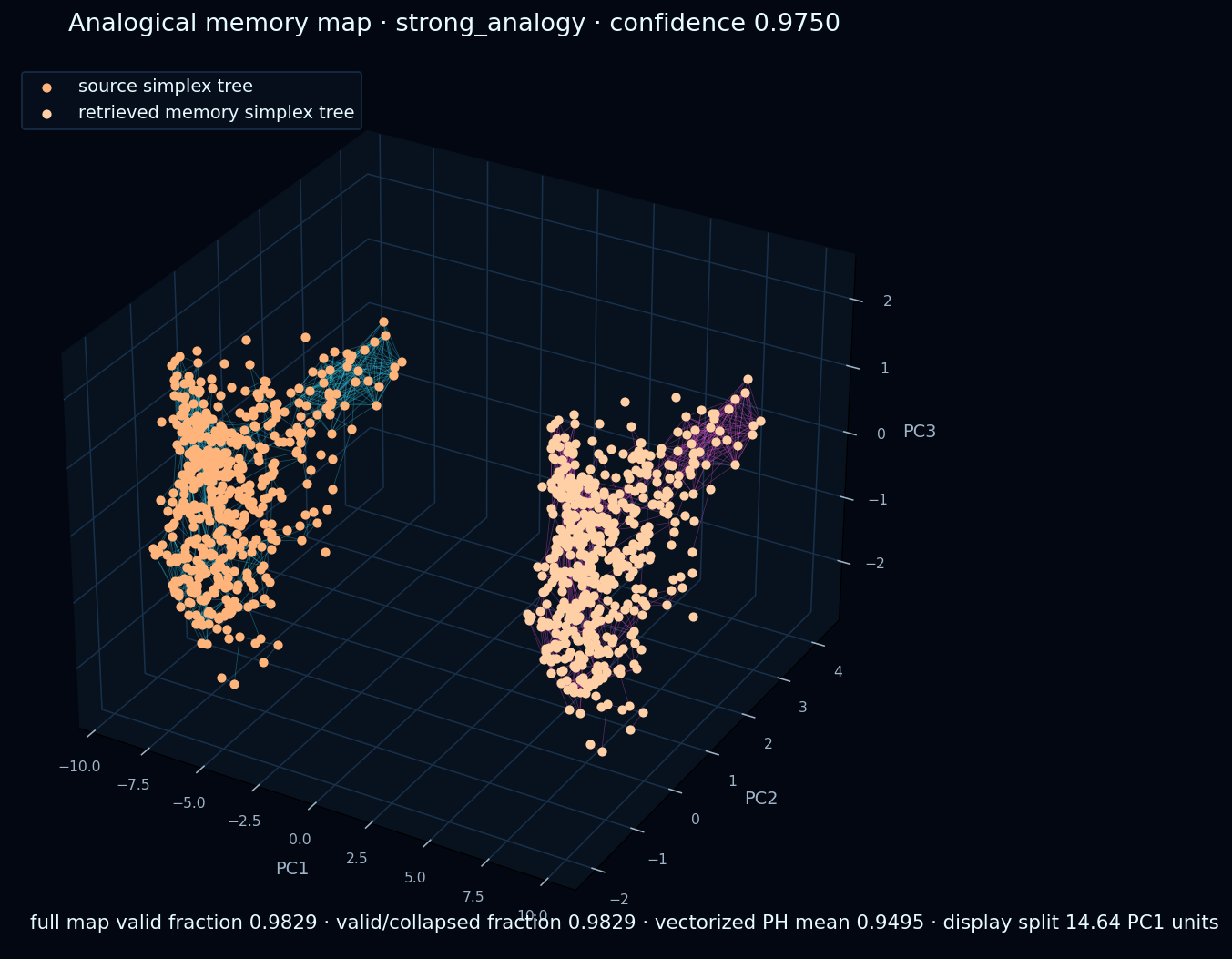
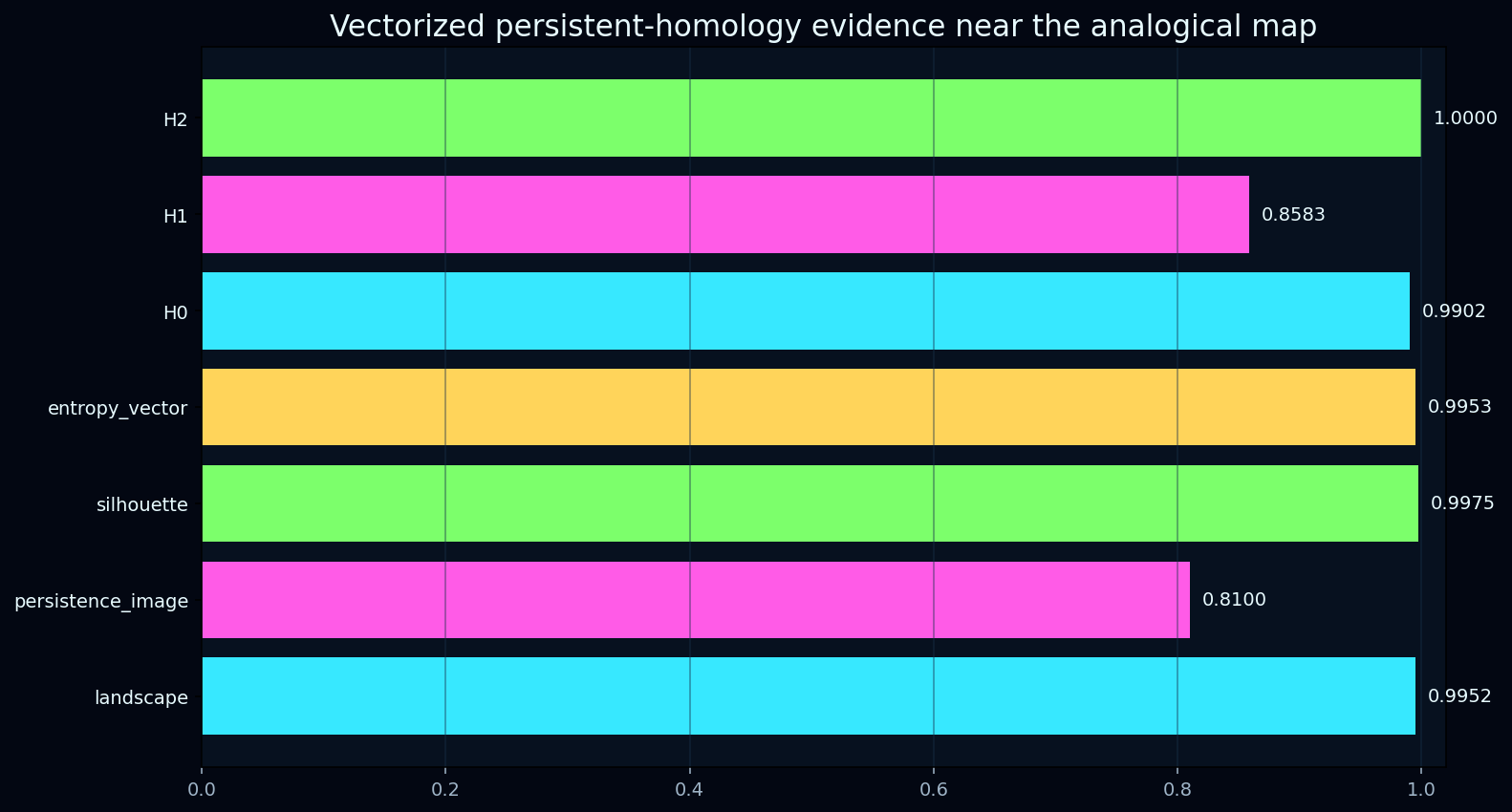

Interactive Analysis Lab
The generated reports use compact native Canvas/SVG interactivity wherever it matters: 3D campaign tetrahedra, 3D reasoning trajectories, filtered reasoning-step simplicial complexes, CAS links, simplex-map summaries, vectorized PH panels, and raw metric tables without forcing giant plotting payloads on first load.
Campaign Metric Tetrahedra and Triangles
Interactive gallery over completed run metrics: multiple tetrahedra plus blue-shaded triangle views for BPB, graph/FoT, toric, topology, BGG, memory, and compactness metrics.
metric tetrahedra · shaded triangles · run labels · BPB color scale · hover raw metricsSimplex Trajectory Report
Potato-safe graph-of-thought trajectory report with exact summary metrics, static screenshots of the full and per-step filtered simplicial complexes, analogical memory maps, vectorized persistent-homology panels, and links to the generated analysis artifacts.
static first · exact metrics · screenshots · 3D PCA · simplex maps · PH panelsGUDHI Persistent Homology
Exact simplex-tree persistent homology, persistence landscapes/images/entropy, vectorized PH features, and Macaulay2 F2[x_level,y_radius] artifacts.
PH records · landscapes/images · entropy · Macaulay2 linksToric Embedding and Staircases
Tropical ring-attention embeddings into toric charts, one-dimensional cones, Miller-Sturmfels staircase modules, staircase overlays, and fan diagnostics.
toric charts · staircases · normal fans · one-dimensional conesCAS Algebra Sidecar
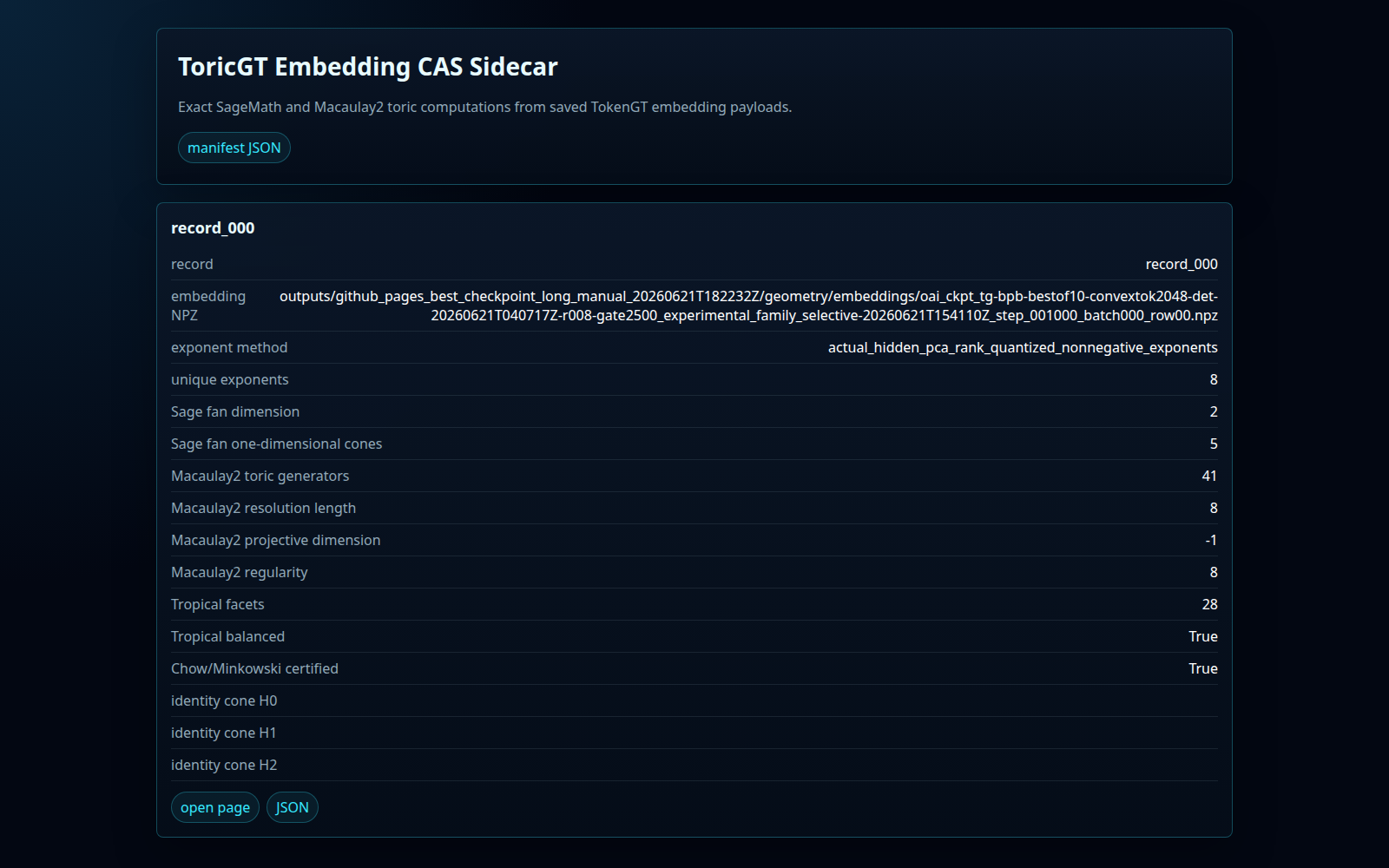
Sage/Macaulay2-backed module, resolution, syzygy, and derived-signature evidence generated for the embedding audits.
resolutions · syzygies · CAS records · derived signaturesToric BGG Category O
Combined Category O explainer and generated audit table for finite highest-weight skeletons, standard masks, BGG differentials, Gale duality, and Koszul checks.
category O skeleton · d² residual · standard masks · Gale dual · Koszul profileForest-of-Thought Method
Dark-mode FoT explanation and interactive embedding-space forest diagram adapted to ToricGT’s graph-valued hidden trajectories.
multiple thought trees · sparse activation · self-correction · BPB-delta rewardConvexTok Tokenization Geometry
Interactive byte-boundary DAG, min-plus equations, LP tokenizer-regret interpretation, and ToricGT TokenGT graphification links.
LP lower bound · min-plus DP · tokenization DAG · tokenizer regretAdvanced Geometry Gallery
Dark-mode diagrams for tropical ring attention, toric fans, Young tableaux, tensor products, persistence modules, and control theory.
Young tableaux · Schur functors · F2[x,y] modules · thought alcovesCentral Construction
ToricGT treats graph-structured data as graph-in/graph-out by default, but gives OAI FineWeb an optional BPB-only flattening path. Tokenization DAGs are graphified, edge tokens are first-class, and tropical dynamic-programming paths are embedded into toric varieties so the model can audit active faces using fans, cones, one-dimensional cones, divisors, sheaf/vector-bundle signals, and commutative-algebra certificates.
Links
| Code | https://github.com/amelie-iska/ToricGT |
|---|---|
| Hugging Face | https://huggingface.co/AmelieSchreiber/toricgt-checkpoints |
| OpenAI Parameter Golf | https://github.com/openai/parameter-golf |
| Submission PR | https://github.com/openai/parameter-golf/pull/2168 |
| Long Paper | assets/toricgt_toric_bgg_rewrite_amelie_schreiber.tex |
| Condensed Paper | assets/toricgt_neurips_condensed.tex |
Next Steps
The next phase turns ToricGT from a compact BPB competitor into a general graph-to-graph reasoning substrate for scientific and multimodal agents.
Continuous Structure Tokenization
ConvexTok suggests a practical recipe: build a candidate graph, solve or relax a global path/cover objective, then round into a compact token inventory. The same idea can be lifted from byte strings to continuous 3D structures by replacing byte-boundary edges with geometric motifs: protein backbone fragments, residue-neighborhood contact patches, ligand pharmacophore neighborhoods, mesh cells, point-cloud patches, and local dynamical states. The tokenization objective should remain tropical-toric: dynamic programming supplies active paths, LP or optimal-transport relaxations supply lower bounds and regret metrics, and toric charts organize the active motif complex into cones, divisors, and sheaf-compatible local neighborhoods.
ToricBLM Continuation
The ToricBLM direction builds on ToricGT by continuing training toward a universal-modality biomedical reasoning model: sequences, atom graphs, protein contact graphs, RNA/DNA structures, complexes, assay facts, trajectories, and scientific claims all become typed graphs with optional continuous coordinates. The mathematical foundation is the bounded-domain universal equivariant graph-to-graph approximation theorem: within fixed graph budgets, a TokenGT-style model can approximate continuous equivariant graph maps, while tropical heads add dynamic-programming and Boolean-circuit-like active support, and ConvexTok/TokenGT positional encodings expose graph grammar structure that ordinary token-only transformers must infer indirectly.
Reasoning, Memory, and Control
Embedding-space Forest-of-Thought and GFlowNet training make reasoning a controlled search process, not a single chain. GraphCG full-rank concept axes make the search directions inspectable. Persistent homology and Toric BGG certificates decide when a retrieved memory is an analogy rather than a superficial nearest neighbor. The proposed thought-alcove control layer then treats reasoning trajectories as dynamical systems inside tropical-toric cells: fan walls are decision boundaries, Lyapunov-style energies discourage unstable exits, ergodic averages diagnose repeated itinerary behavior, and optimal-control objectives choose interventions that keep the model inside productive alcoves while preserving BPB and task reward.
Pinched-Embedding Disambiguation
Jakubowski, Gašić, and Zibrowius argue that static word vectors are better modeled as a pinched manifold: a quotient of a meaning manifold in which several meaning sheets are identified at one word vector. Their diagnostic is operationally useful for ToricGT because our hidden states also identify many roles at one surface token, graph node, ConvexTok edge, or memory key. The proposed extension is to puncture the local neighborhood of an ambiguous token/edge/state, normalize the outgoing directions, compute degree-zero persistent homology with GUDHI, and use the resulting component structure as a sense, role, or analogy gate.
| Finite theorem | If a local embedding neighborhood is the quotient of k disjoint meaning sheets glued at a target point z, then every sufficiently small punctured neighborhood, U with z removed, has k connected components. A Vietoris-Rips filtration sampled densely enough from that punctured neighborhood has k long-lived H0 branches, up to the usual stability error under Hausdorff perturbation. |
|---|---|
| Proof sketch | Before quotienting, choose disjoint local balls around the k preimages of z. Removing z removes the shared glued point, so the images of those balls no longer touch. Thus the punctured quotient neighborhood splits into k components. Persistent H0 detects the merge radii of sampled components; stability of persistence diagrams bounds the change when hidden vectors or approximate nearest neighbors move slightly. |
| ToricGT implementation | For a target token, graph vertex, graph edge, ConvexTok DAG edge, or retrieved memory state, gather k nearest original embedding vectors, remove the target, map neighbors to (v-z)/||v-z||, compute H0 persistence and vectorized summaries, cluster components, then train a small disambiguation head only when the PH gate is confident and BPB loss is not harmed. |
| Training losses | Use a BPB-gated component cross-entropy, a component-margin loss between selected and nonselected local sheets, a PH landscape/image similarity term for analogical retrieval, and a toric fan-refinement term that aligns component boundaries with tropical active-face walls. Keep all weights adaptive, uncertainty-controlled, and subordinate to byte likelihood. |
| Gotchas | Neighborhood size matters: too small misses senses, too large measures global density. Contextual hidden states may already split some senses, so the gate should detect residual pinches rather than force artificial clusters. Comparisons must use original hidden coordinates, not PCA. Synonymy is not the same obstruction as polysemy, and PH pseudo-labels must not leak validation text or override BPB. |
This gives a rigorous path from topological word-sense induction to ToricGT: ConvexTok supplies tokenization DAG neighborhoods; TokenGT supplies equivariant vertex/edge neighborhoods; tropical attention supplies active dynamic-programming sheets; toric charts turn those sheets into cones, walls, divisors, and one-dimensional-cone audits; GraphCG supplies interpretable coordinates; analogical memory requires simplex-map and PH agreement inside the same component; and Toric BGG certificates prevent standard-object leakage across incompatible local sheets. The expected benefit is fewer sense-collisions during retrieval and graph flattening, cleaner memory selection, and lower BPB when ambiguous token choices were causing early likelihood spikes.
Thought Fluid Dynamics
The Tropical Quivers of Archs program frames learned graph-to-graph functions as composable operators with tropical/polyhedral local charts. For ToricGT, that suggests a fluid view of reasoning: hidden trajectories have divergence, circulation, vorticity, boundary flux, and energy. Navier-Stokes-inspired regularizers should be used conservatively, as audits and small penalties, but they give a precise vocabulary for branch merging, turbulence in unstable reasoning zones, and dissipative correction when FoT branches drift. The long-run objective is optimal control over a learned, graph-valued, tropical-toric dynamical system.
Topology of Word Embeddings · ToricBLM blog · Tropical Quivers of Archs · GeoBPE reference · protein structure tokenization benchmark